
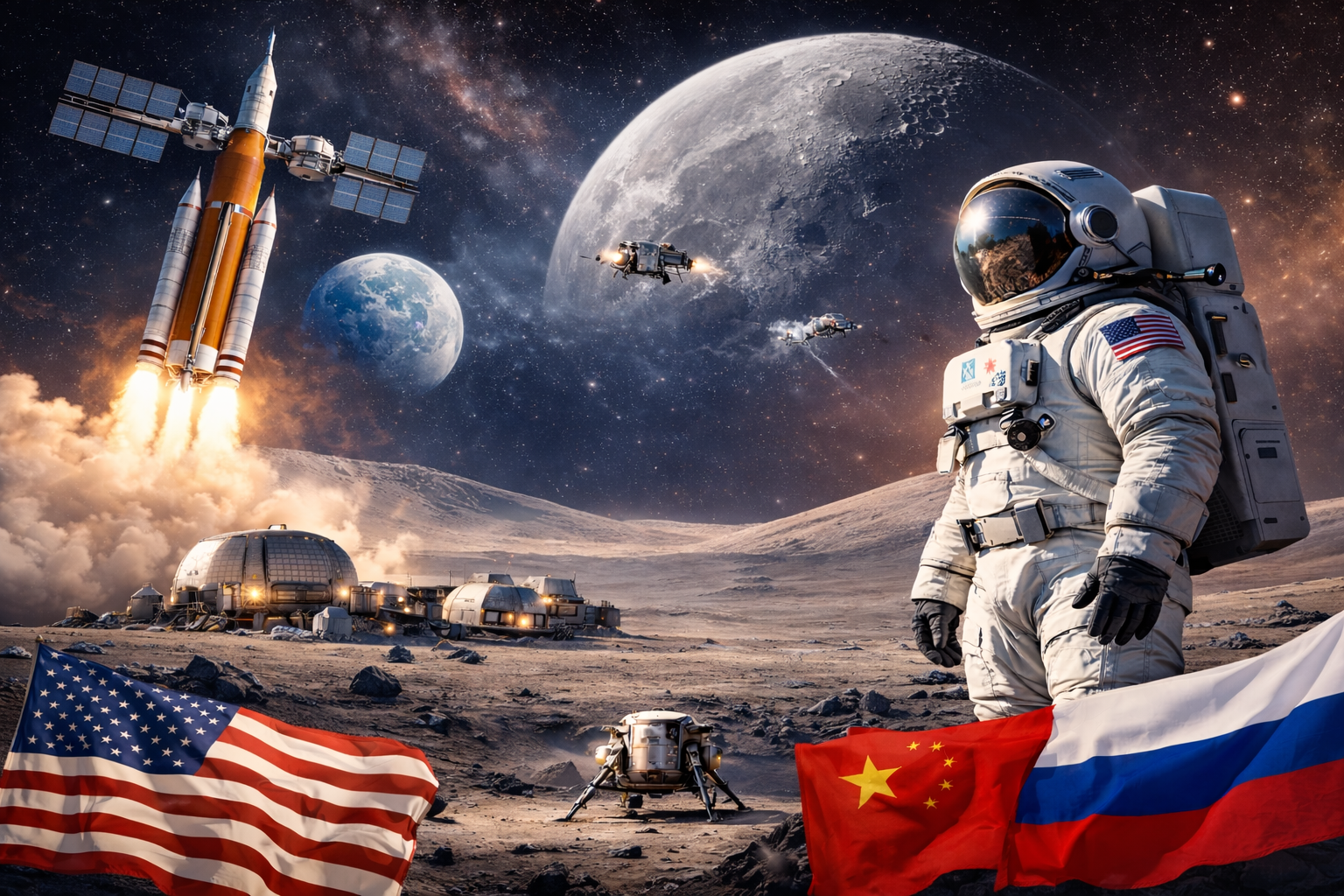
The press and media address issues related to space exploration almost daily. Sector-specific terms such as orbits, rockets, and satellites—just to name a few—now appear regularly even in everyday conversations. Live broadcasts of space launches and technological breakthroughs aimed at humanity’s venture into the cosmos attract significant attention, not only among experts and enthusiasts. Space occupies a substantial place in international politics and fills the agendas of leaders of the world’s major powers. This description may sound like a snapshot of the golden age of space exploration, the historical period that culminated in the 1960s and 1970s of the short twentieth century, as Eric Hobsbawm defined it[1]. Yet much of this picture overlaps with contemporary reality. At the dawn of the year 2026, everything described above applies tout court to the daily lives and interactions of a significant portion of the world’s population. Over time, familiarity with such a scenario had faded, as had political interest in the issue. This was a collateral effect of the end of the Cold War, brought about by the collapse of the Soviet Union in December 1991. The absence of a global-scale strategic adversary for the remaining superpower—the United States—removed many of the incentives that had fueled the space race during much of the second half of the twentieth century. This does not mean that progress ceased or that interest in space exploration disappeared altogether. Confined largely to specialized journals and limited to scientific research purposes, space exploration nonetheless lost much of the prestige and momentum it had previously enjoyed. Today, the geopolitical landscape and the strategic objectives of the major powers—prestige included—have provided the impetus for a new acceleration. An acceleration of almost gravitational magnitude when compared to the slow pace that characterized space exploration efforts around the turn of the millennium.
Within the uneven rhythm of space exploration, one destination more than any other has embodied humanity’s primordial dream: the Moon. Since the last lunar walk carried out by the crew of Apollo 17[2], our satellite remained in the background for nearly fifty years, a symbol of a glorious past rather than a viable future. Today, however, the Moon has returned to the center of global space ambitions. For several years now, a renewed interest in the Moon has been evident—an interest marked by levels of international competition not seen in decades. International cooperation, of course, still exists and remains crucial to achieving objectives. However, it is more limited and animated by a different spirit than the one that prevailed during the golden years of the International Space Station (ISS[3]), which coincided—perhaps not by chance—with the unipolar moment of the United States.
This renewed focus is not driven by nostalgia for the pioneering epic of space conquest. On the contrary, interest in the Moon is profoundly pragmatic. Earth’s natural satellite is rich in raw materials essential for the development of new technologies and advanced materials. Minerals, metallic elements, and rare earths are abundant. What is lacking, however, are clear international regulatory frameworks governing ownership of extracted lunar resources. It is true that the landmark Outer Space Treaty[4], which entered into force in 1967, establishes that space exploration should benefit all humankind and that outer space is to remain a free, peaceful, and neutral environment. The subsequent Moon Treaty[5] of 1979 reiterates that exploration and exploitation of the Moon and other celestial bodies must be conducted peacefully and for the benefit of all. The fact that the Moon Treaty has never been ratified by major spacefaring powers such as the United States, the Soviet Union, and China casts doubt on the genuine willingness to cooperate for all mankind. This uncertainty further reinforces the new space race as a competition in which time is a critical factor, and where arriving first may translate into greater leverage and de facto rights.
In this scenario, NASA—the U.S. space agency—promoted the Artemis Accords in 2020. Eight nations, including European countries such as Italy and Luxembourg, joined immediately, and participation has since expanded to a total of sixty countries. The Artemis Accords, effectively a new U.S.-led space program, were drafted to strengthen international cooperation in the exploration and exploitation of space resources, first and foremost those of the Moon. According to then NASA Administrator Jim Bridenstine, they represent a means to create a safe, peaceful, and prosperous future in space for humanity[6]. Artemis—named after the Greek goddess Artemis, the personification of the crescent Moon—follows a clearly defined yet far from simple path: returning humans to the lunar surface, no longer as mere visitors but as permanent residents, with the aim of developing a local base to support future missions to Mars. In other words: “boots on the Moon!”, as famously proclaimed by the character masterfully portrayed by Steve Carell in the successful series Space Force. This is an epoch-defining shift, destined to generate enthusiasm across much of the planet and to chart a new path of development for humanity—a new (and perhaps final) frontier, a concept deeply rooted in the American mindset. The Artemis program is divided into four phases, each paving the way for the next. The first phase was completed in 2021, while the second—after significant delays—is currently scheduled for no later than April 2026[7]. Each phase represents a gradual increase in complexity, designed to minimize risk as much as possible. The progression moves from an unmanned test flight around the Moon, to a crewed mission along the same trajectory, followed by a lunar landing to explore the surface at a selected site[8], and ultimately to the completion of the Lunar Gateway space station in lunar orbit. The Lunar Gateway will serve as the base from which astronauts can continue missions to the Moon and, in the longer term, as an intermediate port for preparing missions to Mars. It is therefore evident that Artemis is a project of enormous complexity, one that cannot succeed without the participation of partner countries and the contribution of their intellectual, technological, and industrial resources. Similarly, the private sector plays a crucial role in developing the technologies and capabilities required.
Returning to the spirit of the Artemis Accords, however, one discordant note remains—a detail that is far from negligible and revealing of the geopolitical dynamics embodied in the conquest and control of space and its resources. The Accords are intended to promote international cooperation and to deliver benefits for all humanity. Yet a glance at the list of signatory nations immediately reveals the absence of Russia and China. Russia, as historical giant of space exploration and heir to the Soviet Union, has been a major partner—alongside the United States—in key international projects, most notably the ISS. China, meanwhile, has risen to prominence in a relatively short time and is now a recognized space power. The completion of the Tiangong space station[9] and the achievement of the first landing on the far side of the Moon[10] attest to this status. In 2021, China and Russia signed an agreement to build a space station on or around the lunar surface. The two “friends without limits[11]”, united once again in their ambition to reshape the terms of global governance, chose to pursue a project in competition and opposition to the United States and its partners, rather than in cooperation with them. This initiative, known as the International Lunar Research Station, has since attracted the participation of eleven additional countries, including Venezuela—long a vocal opponent of U.S. policies. Ultimately, space exploration and the exploitation of cosmic resources—starting with the Moon—despite stated intentions of development and progress for all humanity, clearly constitute another arena of confrontation among the major powers. A confrontation that will occupy an increasingly prominent place among the challenges reshaping the global order.
In conclusion, the space race has returned as a fast-paced, everyday reality. It is a clear oxymoron: a competition for supremacy in space—itself a vector of power on Earth—presented as cooperation among public and private actors of different nationalities, belonging to rival blocs, ostensibly for the benefit of all humankind. Whatever interpretive lens one adopts—competition or genuine cooperation—it is undeniably fascinating to live in an era in which humanity has once again turned its gaze skyward, not only to admire the star-filled vault above, but to reach it.
November 16th 2025
Original version in Italian
[1] Hobsbawn E.J., Il secolo breve. 1914-1991, BUR Rizzoli, Milan, 2020.
[2] Spacewalk performed by Eugene Cernan and Harrison Schmitt on December 14th 1972.
[3] A space station located in low Earth orbit whose construction began in 1998. The major agencies of the planet are collaborating on the project: CSA (Canada), ESA (European agency to which belongs also the Italian Space Agency), JAXA (Japan), Roscosmos (Russia) e NASA (United States).
[4] United Nations Office for Outer Space Affairs, https://www.unoosa.org/oosa/en/ourwork/spacelaw/treaties/introouterspacetreaty.html
[5] United Nations Office for Outer Space Affairs, https://www.unoosa.org/oosa/en/ourwork/spacelaw/treaties/moon-agreement.html
[6] NASA press release, October 13th 2020, https://www.nasa.gov/news-release/nasa-international-partners-advance-cooperation-with-first-signings-of-artemis-accords/.
[7] Kraft R. H., NASA Progresses Toward Artemis II Moon Mission, “Nasa website”, November 20th 2025, https://www.nasa.gov/missions/artemis/artemis-2/nasa-progresses-toward-artemis-ii-moon-mission/
[8] The south pole of the Moon.
[9] Operational in low Earth orbit since 2022.
[10] Accomplished by the probe Chang’e 4 on January 3rd 2019.
[11] As stated by Vladimir Putin and Xi Jinping, presidents of the Russian Federation and the People’s Republic of China respectively, in February 2022.