
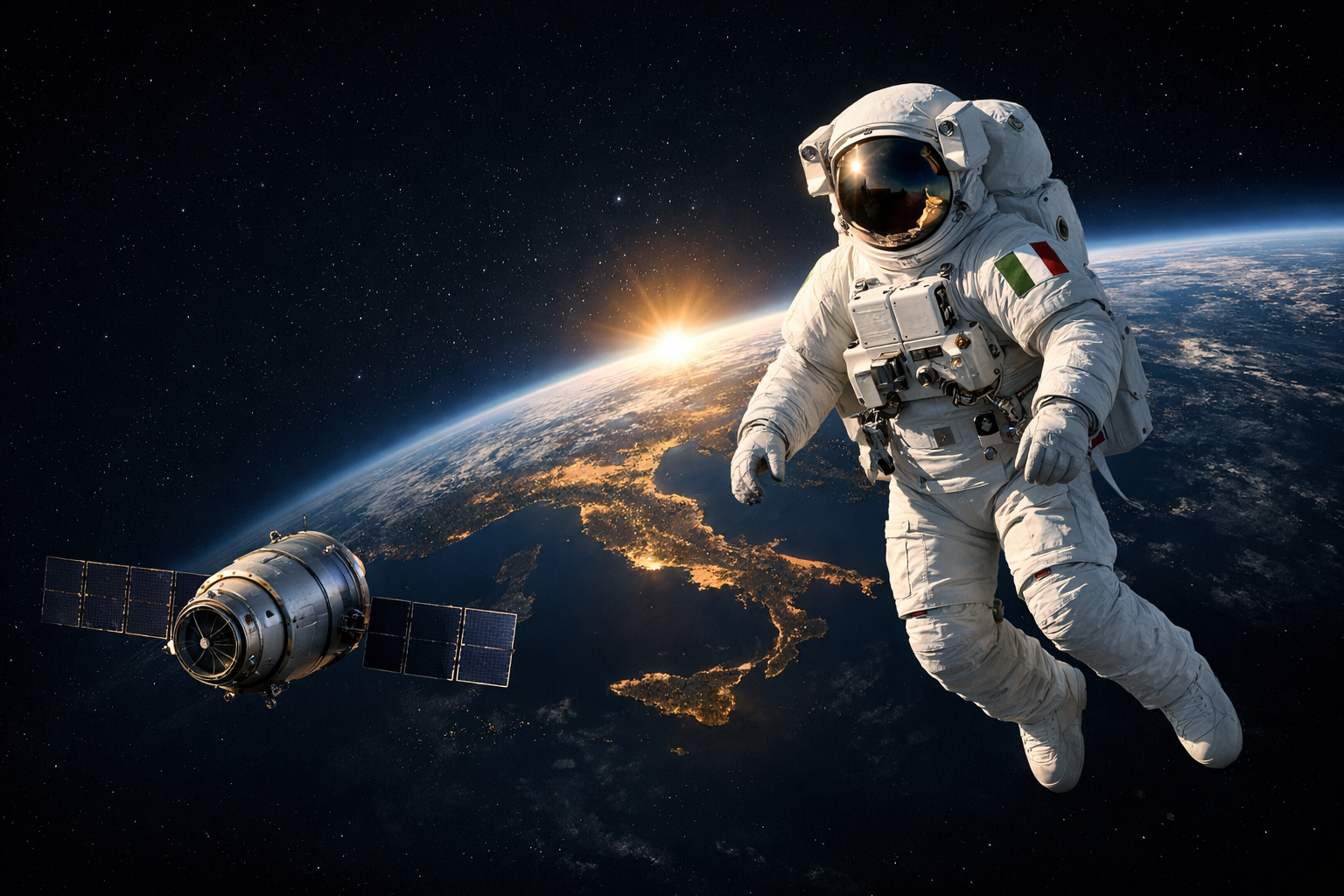
The first part of the conversation with Valentina Sumini, Visiting Professor at Polytechnic University of Turin, Research Affiliate and Space Architect at MIT[1] Media Lab – Space Exploration Initiative, R&T senior engineer at Coesia, explored key aspects of their extensive experience as a space architect and outlined several of the core components shaping space exploration, as well as the prospective creation — within a not-so-distant future — of environments suitable for human life on celestial bodies such as the Moon and Mars. In this second part, Sumini focuses on the contribution that Italy, as a member state of the ESA[2] and the first country to sign the Artemis Accords, can make to the exploration of space.
- You have collaborated with Italian excellence in the culinary and food production sectors to bring Italian quality into orbit. Could you provide some examples?
I would like to mention the design of the Engineered Space Kitchen, a fully-fledged space kitchen that astronauts can use to autonomously prepare meals. The system is conceived to optimize the transformation of raw materials grown in greenhouses, translating them into a balanced menu that takes into account both astronauts’ nutritional requirements — in terms of macro and micronutrients — and their personal tastes. It is important to remember that astronauts come from very diverse cultural and culinary backgrounds. In this context, the introduction of artificial intelligence will be crucial in automating menu generation, adapting it to the availability of raw materials — which varies according to production cycles within hydroponic, aeroponic, or aquaponic greenhouses — and to individual preferences, while balancing efficiency, health, and variety. Another key aspect concerns the trade-off between automation and human involvement. A dedicated study conducted by engineers from Coesia in collaboration with chefs and nutritionists from Giovanni Rana’s team highlighted how beneficial it is, even from a psychological standpoint, to maintain direct contact with plants and preserve a degree of manual involvement in food preparation. This not only improves overall well-being, but also fosters an emotional connection with the environment, an essential element under conditions of prolonged isolation such as those experienced in space. In other words, automation and robotics are welcome, but it is equally important to actively involve astronauts, making them participants in the meal-preparation process. The space kitchen is therefore designed with user-support mechanisms that guide astronauts in cooking their own dishes, effectively turning them into space chefs. The Engineered Space Kitchen has already been successfully tested at ESA’s European Astronaut Centre in Cologne, with the participation of the German astronaut Matthias Maurer, who took part in mission SpaceX Crew-3 for the Expedition 66 aboard the ISS[3]. On that occasion, Maurer was also able to interact directly with the project, introducing modifications through immersive technologies such as extended reality, thus contributing actively to the development of the space kitchen in a genuine astronaut–designer co-design process.
- How much can the Italian system contribute, in terms of expertise, resources, and technologies, to space exploration?
Italy can contribute a great deal to space exploration, both through its industrial sector and through the experience developed by the Italian Space Agency, without overlooking the crucial role played by universities and research institutions. The country boasts centers of excellence and highly specialized know-how across numerous strategic fields: from aerospace engineering to materials science, from robotics to space medicine. This network of expertise — nurtured by synergies between public institutions, universities, and companies — is capable of providing concrete and qualified contributions to major international programs. Lunar exploration projects alone, which today represent the most immediate and realistic objective facing humanity, offer a clear example. In this context, Italy stands out as a credible and competitive partner, capable of playing an active role in the development of infrastructures, habitats, and life-support systems required for future lunar missions and beyond.
- How important is collaboration with academia for the success of space programs?
In my view, collaboration with academia is fundamental to the success of space programs, because university research often adopts a broad, visionary perspective, capable of moving beyond the immediate constraints of technology. As I often tell my students, having what we might call a “clean slate” — the ability to design Martian or lunar environments from scratch — means being able to imagine not only technological solutions, but also cultural, social, and symbolic ones. It means asking how new human communities in space will emerge and evolve. Projects of this scale are comparable to the construction of the great cathedrals of the past: undertakings that will require decades, perhaps centuries, to be completed as we envision them today. This is an endeavor that will span generations and demand unprecedented levels of cooperation among human beings. In this scenario, the role of universities — particularly institutions such as the Polytechnic of Milan, the Polytechnic of Turin, and the MIT, where I am engaged in teaching and research, and which share a vision of democratizing access to space — is to broaden the design horizon. When collaborating with industry or space agencies, universities are tasked with proposing bold, systemic visions for future multiplanetary communities. Adopting a holistic approach means not only imagining how we will build on the Moon and Mars, but also how we will live there: what our daily rituals will be, how relationships will form, and what emotional and cultural needs will arise. Who better than students, researchers, and younger generations — who may well become the first citizens of space — to imagine and guide the design of these infrastructures? Universities are the places where such visions can be born, developed, and integrated into future space programs.
- Do you see differences between Italy and other countries where you have worked directly?
I would say no; there are no major differences. In all the countries where I have worked, I have encountered a strong openness toward academia. Students and researchers today represent a fundamental resource in innovation processes, particularly in dialogue with industry, where ideas are often evaluated primarily in terms of short-term return on investment. In universities, by contrast, “return” is measured in terms of intellectual property and the ability to generate innovation, including disruptive innovation. It is precisely this different perspective — free from immediate production constraints — that provides immense value to industry. Students’ creativity, in particular, enables the proposal of new and flexible solutions, even when they initially appear impractical. This freedom makes them especially valuable to professionals who have spent years in the sector and are well acquainted with the many don’ts: everything that, according to experience and established practice, cannot be done. Similarly, researchers bring approaches and methodologies that challenge the status quo, offering interpretive frameworks that may elude those deeply embedded in operational routines. As a result, collaboration between industry and universities is extremely productive, precisely because it brings together experience and vision, rigor and imagination, fostering outcomes that are often unexpected and highly innovative.
- What is Italy’s role in the international context, both as a member of the European Space Agency and through collaborations with agencies such as NASA?
Italy plays a highly active and internationally recognized role in the space sector, both as a leading member of the European Space Agency and through bilateral collaborations with agencies such as NASA. Italian contributions range from exploration missions to the design and construction of satellites, as well as the development of technologies for human habitation in space. The Italian industrial sector is particularly strong: companies such as Thales Alenia Space and Leonardo are involved in key programs, including habitable modules for the ISS and for the future Lunar Gateway. At the same time, younger and highly innovative players—such as D-Orbit, engaged in space debris removal, and Argotec, known for designing the first espresso machine for microgravity, stand as examples of excellence and dynamism. Italy’s contribution is also distinguished by its astronauts, such as Samantha Cristoforetti and Luca Parmitano (to name just a few from a much longer list within the Italian Space Agency’s astronaut corps), who have represented the country in top-tier international missions. What makes the Italian system especially interesting, however, is its ability to involve sectors not traditionally associated with space, such as fashion and food design. One example is the recent collaboration between Prada and Axiom Space in the development of the spacesuit for the Artemis III mission, or the Pasta in space project promoted by Barilla during mission Ax-3, which brought Italian pasta aboard the ISS to test its taste, texture, and performance in microgravity. These initiatives demonstrate how the involvement of non-space companies can act as a driver of cross-sector innovation, contributing to the emergence of a genuine Italian space economy. Finally, it is worth recalling that Italy was the first European country to sign the Artemis Accords with NASA, reinforcing its commitment to building a sustainable human presence on the Moon, a strong signal of Italy’s strategic positioning within the global space landscape.
- Space has returned to government agendas after years of stagnation, once again emerging as a competitive arena. Is international cooperation still relevant?
Space has decisively returned to government agendas, reasserting itself as a domain of strategic competition among major powers. That said, I firmly believe that international cooperation remains an indispensable factor for ensuring equitable, sustainable, and peaceful development of space activities. A concrete and virtuous example is the International Space Station, the product of collaboration among space agencies from countries with very different political interests and orientations. It demonstrates that it is possible to build together in space, beyond terrestrial divisions. This approach can — and should — be replicated in new contexts, such as the design of lunar bases or the shared management of extraterrestrial resources. On the Moon, for instance, strategic resources are limited: from polar water ice, essential for survival and fuel production, to materials such as regolith, which can be used for in-situ construction. There are also traces of valuable metals, including gold and rare earth elements, which are fundamental for electronics. While currently present in limited quantities, it is reasonable to assume that future extraction technologies could make these resources economically and geopolitically significant. For this reason, cooperation is not merely desirable, it is necessary. The 1967 Outer Space Treaty establishes that no nation may claim sovereignty over a celestial body and that space must be used for peaceful purposes and in the interest of all mankind. However, this principle must be updated and strengthened in light of new challenges linked to resource exploitation. Only through shared international governance will it be possible to avoid uncontrolled competition and ensure that space becomes an environment of global cooperation, capable of reflecting the best values of our civilization beyond Earth.
- How do you view the entry of private companies, such as SpaceX, into the sector? Do they act as accelerators of innovation and progress, or do they also raise regulatory concerns?
In my view, the entry of private companies such as SpaceX into space exploration represents an important resource, capable of concretely accelerating innovation and access to space. In the United States, this approach has already proven highly effective: today, SpaceX offers a realistic prospect of developing a reusable and sustainable launch system capable of reaching the Moon and, in the longer term, Mars within relatively short timeframes. The role of the private sector will be crucial going forward, especially when considering long-term strategic objectives. Transforming the Moon from a purely scientific outpost into a permanent base from which to continue exploration toward Mars is an immense challenge. One that, in terms of scientific, technological, and economic resources, could surpass even those mobilized during the Manhattan Project. No single country can sustain such an effort alone. For this reason, it is essential to develop a solid and shared public–private platform, in which technologies developed by private actors are made available to the international community at progressively more accessible costs. Private companies can accelerate progress, but they must do so within a clear regulatory framework that prevents speculative excesses and safeguards principles of equity and global cooperation. There are certainly risks: private-sector involvement must not become a loophole for bypassing the ethical principles that guide space exploration. We must remember the spirit of the Apollo missions — the famous for all mankind — and remain vigilant to ensure that space remains a common good, rather than a domain dominated exclusively by commercial logic. From this perspective, I find the work carried out by institutions — such as the Space Economy Lab of the Bocconi University in Milan — particularly valuable, as it is precisely focused on analyzing these balances between market forces, technology, and governance, with the aim of building an inclusive and sustainable space future.
2 November 2025
Original version written in Italian
[1] Massachusetts Institute of Technology.
[2] European Space Agency.
[3] International Space Station: a space station located in low Earth orbit, whose construction began in 1998. The project involves collaboration among the world’s major space agencies: CSA (Canada), ESA (the European agency, which includes the Italian Space Agency), JAXA (Japan), Roscosmos (Russia), and NASA (United States).